

A food trend can go from “have you seen this?” to “wait, is this already over?” in about the time it takes most brands to get a single piece of content client approved and through legal review.
That’s the uncomfortable truth at the center of social media right now, and it’s especially true for food and foodservice brands. Food manufacturers, grocery and retail brands, and c-store suppliers weren’t built for this speed. They were built for planning cycles, product testing, and careful messaging. Social media doesn’t care about any of that. It moves on TikTok time, and TikTok time waits for no one.
So how should food brands think about trend speed? Not by trying to win a race they can’t win, and not by sitting it out entirely. The answer is somewhere in the middle, and it starts with understanding why the speed problem is real before deciding what to do about it.
Why Food Content Moves Faster Than Most
Food is uniquely suited to viral speed. It’s visual, it’s universal, and everyone has an opinion about it. A single recipe hack, snack combo, or grocery find can rack up millions of views before most brands even know it exists. In fact, according to the 2025 Sprout Social Index™, 27% of consumers think jumping on a trend is only effective within 24-48 hours of its lifespan, a narrower window than most approval processes can move in. Add in the fact that platforms increasingly reward native, in-the-moment content over polished production, and you get a landscape where the brands moving fastest often win the most attention, regardless of budget.

For brands selling through retail and c-store channels, this plays out at the point of purchase too. Shoppers are discovering products through social content, and according to the 2025 Sprout Social Index™, 81% say social drives them to make impulse purchases. That means they’re expecting to find products on shelf or in the case that same week. When there’s a lag between what’s trending online and what’s available in stores, brands lose the moment entirely.
Why Chasing Every Trend Is the Wrong Move
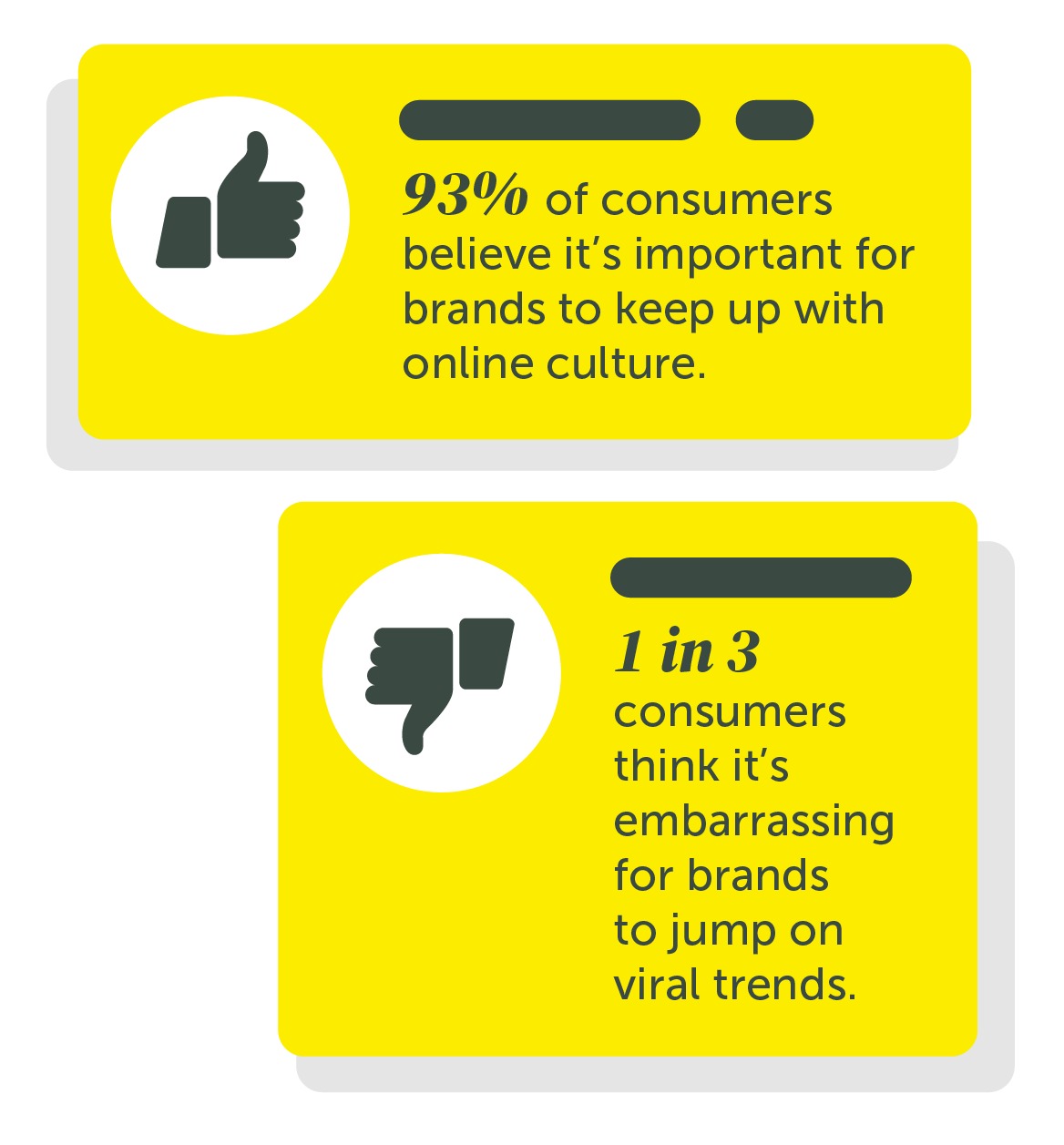
According to the 2025 Sprout Social Index™, 93% of consumers believe it’s important for brands to keep up with online culture, but simply jumping on the latest trends can backfire; a third of consumers think it’s embarrassing for brands to do so.
Here’s where it gets tricky. The instinct for a lot of marketing teams is to treat speed as the whole strategy: see a trend, jump on it, post fast, hope it lands. For food brands, that instinct can work against them in a few specific ways.
First, there’s the approval problem. Product claims, nutrition information, and brand guidelines exist for good reason, and they don’t move at meme speed. Rushing a post to catch a trend can mean skipping steps that protect the brand, or the accuracy of what’s actually being said about a product.
Second, there’s the fit problem. Not every trend is a trend for every brand. A viral format that feels perfect for a retail snack brand might feel completely wrong for a B2B foodservice supplier talking to operators and distributors. Jumping on something just because it’s trending, without asking whether it actually serves the brand’s audience or voice, tends to produce content that feels forced—and audiences can tell.
Third, there’s the burnout problem. Trend-chasing is exhausting for teams, and keeping pace with it takes real, sustained effort. According to the 2025 Sprout Social Index™, 94% of social practitioners feel they have to be “chronically online” to work in social media. Brands that treat every trend as a must-jump-on-it moment end up spread thin, reactive, and less authentic, which shows up in the quality of everything else they’re putting out.
The Middle Path: Built-In Agility, Not Blind Speed
The brands that handle this well aren’t the fastest. They’re the ones who’ve built agility into their process ahead of time, so that when the right trend shows up, they can move quickly without cutting corners.
In practice, that looks like a few things:
- Pre-approved flexibility. Brand guidelines and approval processes that account for realtime content, not just planned campaigns, so a trend doesn’t have to sit in a queue for two weeks.
- A clear filter. A quick, honest gut check before jumping on anything: does this fit the brand’s voice, does it serve the audience, and can it be done accurately and well? If the answer to any of those is no, it’s fine to let it pass.
- Evergreen content as a foundation. Trend content works best as a layer on top of a strong baseline of planned, on-brand content, not as the entire strategy. That way, missing a trend, or watching one move too fast to catch, isn’t a crisis.
- Local and niche moments over mass trends. Sometimes the better move isn’t chasing the biggest viral trend, but noticing a smaller, more relevant moment for a brand’s specific audience, whether that’s c-store operators, foodservice distributors, or shoppers in a specific retail market. Those moments move a little slower and reward brands that show up consistently.

Speed Isn’t the Whole Game
Trends will keep moving fast, and food content will keep being some of the fastest-moving content out there. That’s not going to change. What can change is how a brand prepares for it: not by trying to out-sprint the algorithm, but by building the kind of flexibility and judgment that lets a team move quickly when it matters, and skip the noise when it doesn’t.
That’s the version of “keeping up” that holds up over time.
Building that kind of agility takes the right systems, the right partners, and a clear point of view, and that’s where we come in. IN Food Marketing & Design works with food and foodservice brands to build social strategies that move fast without losing what makes them worth following. If that’s the kind of partner you’re looking for, get in touch with us.

